
Temperature conversion between Celsius and Fahrenheit is one of the most commonly used calculations worldwide. While most countries use the Celsius scale for weather forecasts, scientific measurements, and everyday temperature readings, the Fahrenheit scale remains the standard in the United States and several territories. Because of this, travelers, students, cooks, engineers, and researchers often need to convert temperatures quickly and accurately.
Whether you are checking a weather forecast, comparing climate data, following an international recipe, or studying scientific materials, understanding the relationship between Celsius and Fahrenheit is extremely useful. The Celsius scale is based on the metric system and uses water’s freezing point (0°C) and boiling point (100°C) as reference points. Fahrenheit uses different reference values, with water freezing at 32°F and boiling at 212°F.
- PROČITAJTE VIŠE: UnitConverters.net Review | Free Online Converter for Hundreds of Measurement Units
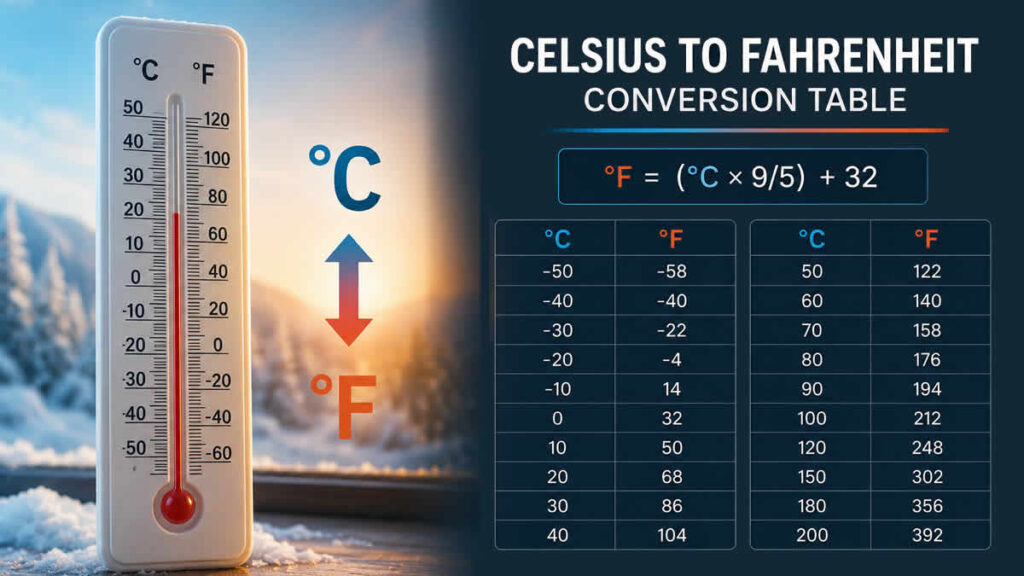
As a result, a mathematical formula is required to convert temperatures from one scale to the other. Fortunately, once you understand the formula, conversions become straightforward. The detailed Celsius to Fahrenheit conversion table below provides a quick reference for temperatures ranging from -50°C to 200°C, helping you find accurate values without using a calculator.
Celsius to Fahrenheit Formula
To convert Celsius (°C) to Fahrenheit (°F), use the following formula:
°F = (°C × 9/5) + 32
Example Calculations:
- 0°C = (0 × 9/5) + 32 = 32°F
- 25°C = (25 × 9/5) + 32 = 77°F
- 37°C = (37 × 9/5) + 32 = 98.6°F
- 100°C = (100 × 9/5) + 32 = 212°F
Celsius to Fahrenheit Conversion Table
| Celsius (°C) | Fahrenheit (°F) |
|---|---|
| -50 | -58 |
| -45 | -49 |
| -40 | -40 |
| -35 | -31 |
| -30 | -22 |
| -25 | -13 |
| -20 | -4 |
| -15 | 5 |
| -10 | 14 |
| -5 | 23 |
| 0 | 32 |
| 5 | 41 |
| 10 | 50 |
| 15 | 59 |
| 20 | 68 |
| 25 | 77 |
| 30 | 86 |
| 35 | 95 |
| 40 | 104 |
| 45 | 113 |
| 50 | 122 |
| 55 | 131 |
| 60 | 140 |
| 65 | 149 |
| 70 | 158 |
| 75 | 167 |
| 80 | 176 |
| 85 | 185 |
| 90 | 194 |
| 95 | 203 |
| 100 | 212 |
| 105 | 221 |
| 110 | 230 |
| 115 | 239 |
| 120 | 248 |
| 125 | 257 |
| 130 | 266 |
| 135 | 275 |
| 140 | 284 |
| 145 | 293 |
| 150 | 302 |
| 155 | 311 |
| 160 | 320 |
| 165 | 329 |
| 170 | 338 |
| 175 | 347 |
| 180 | 356 |
| 185 | 365 |
| 190 | 374 |
| 195 | 383 |
| 200 | 392 |
Common Uses for Celsius to Fahrenheit Conversions
Celsius to Fahrenheit conversions are commonly used when reading international weather forecasts, planning trips abroad, and following recipes from different countries. For example, a summer day with a temperature of 30°C corresponds to 86°F, while a hot day of 40°C equals 104°F. Water freezes at 0°C (32°F) and boils at 100°C (212°F), making these values useful reference points for everyday life. Human body temperature averages around 37°C or 98.6°F, which is another commonly searched temperature conversion.
Students and professionals working in science, engineering, and meteorology often use both scales. Having a reliable conversion table allows quick access to temperature values without manually calculating every conversion. This saves time and helps prevent mistakes when working with important data.
Frequently Asked Questions
How do I convert Celsius to Fahrenheit?
Multiply the Celsius temperature by 9, divide by 5, and add 32. The formula is:
°F = (°C × 9/5) + 32
What is 0°C in Fahrenheit?
0 degrees Celsius equals 32 degrees Fahrenheit.
What is 20°C in Fahrenheit?
20 degrees Celsius equals 68 degrees Fahrenheit.
What is 37°C in Fahrenheit?
37 degrees Celsius equals 98.6 degrees Fahrenheit, which is considered normal human body temperature.
What is 100°C in Fahrenheit?
100 degrees Celsius equals 212 degrees Fahrenheit, the boiling point of water at standard atmospheric pressure.
Which countries use Fahrenheit?
The Fahrenheit scale is primarily used in the United States and a few territories, while most countries use Celsius.
Why is Celsius more common worldwide?
Celsius is part of the metric system and is easier to use in scientific calculations because it is based on decimal units and standardized reference points.
Related Temperature Conversion Tables
Continue exploring temperature conversions with this useful guide:
This conversion chart help users quickly switch between the world’s most widely used temperature scales and provide additional reference data for education, travel, science, and everyday use.